 English articles
 Mafie ● Resistenze
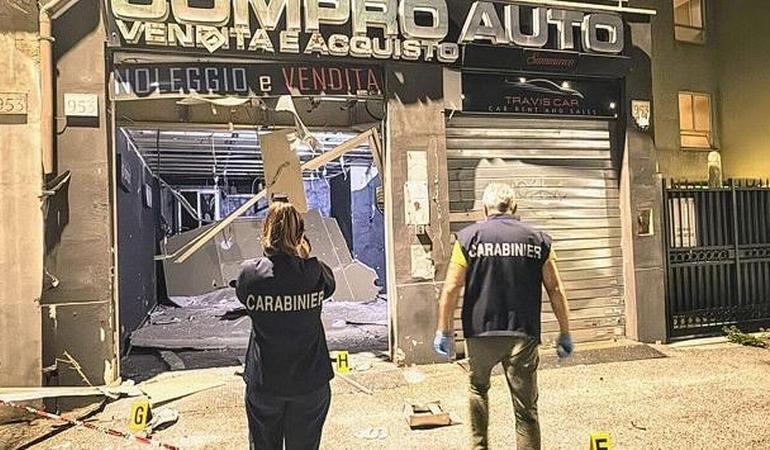
A Roma Est 15 bombe da settembre. L'ipotesi: clan che si riorganizzano

17 novembre 2026
Several companies in Russia manufacture PFAS—synthetic chemicals prized for their resistance to extreme heat, yet hazardous to living organisms—which are then imported into Europe. The import supply chain is composed of intermediary companies based in Germany and Israel, road freight haulers, multinationals leasing specialized containers, and finally the end buyers: major PFAS producers like Syensqo (formerly Solvay). This intricate system enables the purchase of compounds that European policymakers want to ban, but which key industries—especially the automotive and defense sectors—are unwilling to replace. Through import records, confidential emails, and reporting along the Russian border, lavialibera (an Italian investigative journalism outlet) has identified the key players feeding the arteries of the European and global chemical industries.
It is a two-part story that begins in St. Petersburg and ends in Alessandria, in northern Italy. The first installment stopped in Birkenau, outside the quiet German house serving as the registered office of one intermediary. The second moves first to Israel—where a new company is born—and then back to Estonia, along the Russian border, before finally reaching Italy. Below is the second part of the investigation.
With two and a half euros in share capital, a single shareholder, and a registered office in a quiet residential neighborhood of Netanya, Israel, Elastofluor Ltd is the company through which, since autumn 2022, PFAS manufactured by the Russian firm Anles have passed—on paper—on their way to Italy. Starting in September of that year, its name began appearing as the "trader" (an intermediary buyer) on bills of lading for 8-CNVE—a fluorinated monomer—bound for the Syensqo plant in Spinetta Marengo, near Alessandria. In this type of trade, the trader purchases the goods in its own name, assumes legal ownership, and resells them at a markup, taking on the commercial risk. On shipping manifests, it serves as the middle link between sender and recipient.
Read the first episode of the investigation about the PFAS trade from Russia to Europe
Elastofluor was incorporated on June 12, 2022, just over three months after Russia launched its full-scale invasion of Ukraine. As Brussels rolled out waves of sanctions against Moscow, companies trading with Russian suppliers—even in goods not initially subject to direct bans—began devising workarounds, such as setting up companies in other countries. Israel’s corporate registry lists a sole shareholder, who also serves as sole director and CEO: Mikhail Kogan (registered in Israel as Michael Kogan), a Russian businessman holding Israeli citizenship, whose family controls Anles.
Founded in St. Petersburg in 2001 by Mikhail’s father, chemistry professor Lev Kogan, in a small plant wedged between a railway line and the Neva River, Anles is one of the few—if not the sole—suppliers worldwide of 8-CNVE. This chemical building block is essential for producing fluoroelastomers: high-grade synthetic rubbers capable of withstanding extreme temperatures and corrosive agents, used in aerospace gaskets and in coverings for defense vehicles. Until the summer of 2022, Anles’s products entered Europe through another family-controlled intermediary, the German-registered firm Ftoran. Then, on shipping paperwork, Ftoran gave way to Elastofluor. The product, the sender, and the final recipient remained identical; only the country through which the transaction was routed on paper changed.
Elastofluor is a minuscule entity. Its paid-in capital totals 10 Israeli shekels—roughly €2.50—divided into 100 shares worth ten agorot each, all held by Kogan. The corporate registry lists a generic business purpose that reveals nothing about its actual operations. No financial guarantees are on file, and its articles of association have never been amended. The director’s personal address is listed as an apartment in Nesher, a town on the outskirts of Haifa, roughly an hour’s drive from the company’s official address.
Pfas provoke cancers, but for Mario Draghi they serve the green transition
That registered office is located at 20 Natan Yonatan Street in Netanya, a coastal city about 30 kilometers north of Tel Aviv. Satellite imagery shows a residential neighborhood of detached villas, low-rise houses, and private gardens. There are no warehouses, loading bays, or facilities capable of storing hazardous chemicals. Nor do the substances ever physically pass through Israel: on shipping manifests, the destination country code remains EE—Estonia.
In Netanya, the Russian chemical is neither manufactured nor processed; Elastofluor’s role appears purely formal. Bills of lading confirm this pattern: whenever Anles shipments leave St. Petersburg bound for European buyers, Elastofluor consistently appears as the trader. By contrast, no intermediaries appear on manifests for shipments headed to Japan or China.
European trade rules on this matter are unambiguous. Under the Union Customs Code, goods originate in the country where they underwent their last substantial transformation. Routing or invoicing a shipment through a company in Israel or Germany alters nothing: a monomer synthesized by Anles remains legally Russian. EU Regulation 833/2014, adopted in 2014 after Russia’s annexation of Crimea, goes further, prohibiting the direct or indirect purchase, import, or transfer into the EU of restricted goods originating in or exported from Russia, as well as any circumvention of sanctions—including via third-country traders. Since January 2026, a new Italian law has written the violation and circumvention of EU sanctions into the criminal code, with prison terms of two to six years and heavy fines for companies.
Meanwhile, Elastofluor has run into administrative trouble. Its last filed financial statements date back to 2024, and its annual corporate fees for 2025 and 2026 remain unpaid, leaving an outstanding debt of 3,554 shekels (under €1,000). On June 25, 2026, Israel’s Corporations Authority classified Elastofluor as a "company in violation of the law," a designation carrying operational restrictions, though the firm remains formally active.
Lavialibera contacted Mikhail Kogan to ask why he incorporated Elastofluor just months after the invasion of Ukraine, what role the firm plays relative to Anles and Ftoran, and what operations it conducts in Estonia and toward Italy. Kogan did not respond.

Inchieste, interviste, dati, rubriche:
perché sapere è un diritto, tacere una scelta.
Su carta e digitale
Before sanctions reshaped regional trade, the chemical might have entered Europe through Estonia’s far northeast, where the Gulf of Finland separates two geopolitical worlds. In Sillamäe, a deep-water port was built facing East: the Russian coastline lies just kilometers away, the sprawling Russian terminal of Ust-Luga is visible on the horizon, and on summer nights when Ukrainian drones strike across the border, flames can be seen from the Estonian shore.
At dusk, the port feels like a monument to an economy on pause: idle cranes, empty yards, near-deserted quays. Offshore, the only steady traffic consists of oil tankers bound for Asia—many belonging to Russia’s "shadow fleet" of aging vessels used to bypass Western price caps and sanctions—none of which dock here.
Sillamäe was purpose-built for Russian commerce: a free economic zone where cargo from Moscow could be stored indefinitely before shipping onward to Europe and the Americas. Prior to the war, half the port was Russian-owned, and 90 percent of the goods passing through—chiefly fertilizers and chemicals—originated in Russia. After 2022, Moscow’s shareholders exited, cargo volumes collapsed by more than 80 percent (from ten million to two million metric tons annually), and the workforce shrank from 500 to 200. "Nothing comes from Russia anymore," says Andrey Birov, business development director at Sillamäe Sadam, the port operator. Even before the war, Birov notes, Sillamäe was hardly essential: "From St. Petersburg, cargo could be loaded directly at Ust-Luga and shipped straight to Italy." At most, the Estonian port served as a holding warehouse while awaiting a buyer—a role it no longer plays. If 8-CNVE entered Europe through Estonia, it did not come through here.
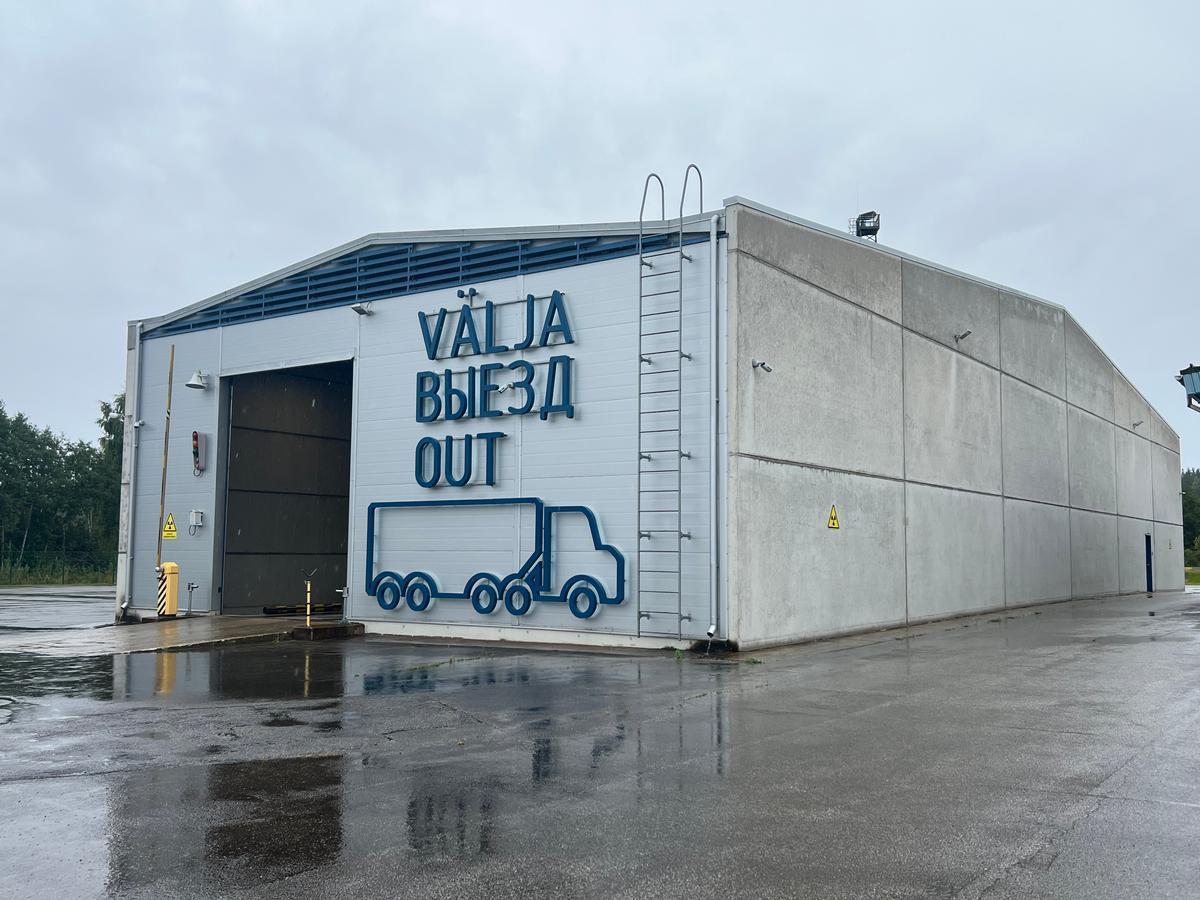
With maritime routes closed off, overland trucking remains. Along Estonia’s border with Russia’s Pskov region, heavy freight passes through two crossings—Koidula and Luhamaa—set amid meadows and forests where the geopolitical divide almost blends into the landscape.
According to figures provided to lavialibera by Pavel Prokopenko of the Estonian Tax and Customs Board, 3,380 trucks crossed from Russia at Koidula and 7,119 at Luhamaa in 2024; in 2025, the figures stood at 2,267 and 8,303, respectively. Overall volume remains steady at roughly 10,000 trucks per year, largely carrying food shipments in transit toward Serbia and Moldova. "We are the only EU country conducting full customs inspections along the eastern border," Prokopenko notes.
At Koidula, chief inspector Kairi Päike describes a two-tier screening system: high-energy X-ray scanners compare every truck against images from its previous crossing ("if an empty cavity appears that wasn't there before, we open the vehicle"), paired with rigorous verification of customs tariff codes, since "changing a single digit is enough to disguise a sanctioned product under another classification." Risk assessments are continuously updated through real-time intelligence sharing among Estonia, Latvia, Lithuania, and Finland.
Since spring 2025, Estonian customs authorities have been empowered to directly initiate criminal investigations into sanctions violations—a remit previously reserved for Estonia’s Internal Security Service (KaPo)—logging 76 cases between April and December 2025, and another 73 in the first eight months of 2026.
Yet one crucial detail stands out: until July of this year, 8-CNVE was not subject to EU sanctions, meaning none of those enforcement statistics apply to them. For more than four years after the invasion, a truck carrying 8-CNVE could legally cross these checkpoints provided its customs code was accurately declared. What remains unclear is whether the chemical physically crossed this border—or whether Estonia, too, was merely a two-letter code printed on a shipping manifest.
There are traces of PFAS even in the blood of European ministers
Tracking down Anles-manufactured PFAS does not necessarily require gazing across the Baltic toward the Russian coast or trekking through Estonian forests to border checkpoints. One need only look to Milan Malpensa, Italy’s second-busiest airport. It was here, between December 2021 and July 2022, that the two PFAS compounds most heavily purchased by Syensqo touched down by air freight—met on the tarmac by trucks belonging to Italian logistics giant Arcese.
For over two decades, Arcese has managed raw materials and finished products on behalf of the Belgian chemical group. Its logistics hub—located along Strada Vicinale Gerola, between the Spinetta Marengo plant and the Milan–Genoa highway—has been listed since 2018 in the national inventory maintained by ISPRA (Italy’s Institute for Environmental Protection and Research) as a lower-tier establishment under the EU Seveso Directive, meaning one with less stringent obligations.
Among the PFAS stored there was a mixture known as PNC, produced by Anles, which arrived at Malpensa by the metric ton between December 2021 and May 2022. Tracing how it entered Italy sheds crucial light on how Russian chemicals move into Europe.
Residents of Alessandria were already familiar with the acronym PNC. It appeared in a safety data sheet—one of the mandatory documents required to renew the plant’s Integrated Environmental Authorization (the operating permit allowing the factory to keep producing legally)—that Solvay submitted in May 2021 to the City of Alessandria’s environment department during meetings on remediating contaminated areas outside the Spinetta Marengo complex. That document explicitly listed Russia’s Anles as the manufacturer.
Chemically, PNC is an oligomer. Returning to the building-block analogy: if a monomer is a single block, an oligomer is a short train of just a few blocks—like a polymer, only shorter. Typically impure, it contains molecular chains of varying lengths, including traces made of just two or three units. These shortest chains are the most mobile, dispersing easily into the environment when discharged into the nearby Bormida River or emitted into the atmosphere from one of the 26 smokestacks at the Syensqo facility. The two-unit chain corresponds to the substance widely known as GenX; since 2020, ARPA (Piedmont’s regional environmental protection agency) has detected it in both the river and the groundwater aquifer beneath the plant. Nor does the contamination stop at the factory gates: in March 2025, lavialibera sampled private wells belonging to local residents a few kilometers from the site, detecting GenX at concentrations of dozens of nanograms per liter. (The findings were detailed in an earlier investigation into PFAS contamination in private wells around Alessandria.)
There are Pfas in the blood of those who live near the Solvay plant in Alessandria
According to the Import Genius database, the first metric ton of the compound left Anles in July 2019 bound for Solvay’s research center in the province of Milan. In subsequent months, shipments shifted to the Spinetta Marengo production site via Arcese trucks. Then, prior to Russia’s invasion of Ukraine, PNC took to the skies: in December 2021, nearly two metric tons in liquid form landed at Malpensa and were loaded onto an Arcese truck. Direct flights stopped when air routes between Russia and Europe were hit by the first sanctions over the invasion of Ukraine. The last shipment—containing nearly a ton of both PNC and 8-CNVE—landed in July 2022.
In 2023, the company formally ceased purchasing PNC, bringing an end to deliveries at the Arcese warehouse where the logistics operator had stored it for the multinational.
For four years, the substance arrived by the ton, yet neither the company storing it nor the manufacturer using it ever applied for specific authorization to handle it. Nor was it registered in the European chemicals database managed by the European Chemicals Agency (ECHA). PNC did, however, appear under the EU’s CLP Regulation, which requires manufacturers and importers to classify, label, and package hazardous substances. It was not the first time a chemical had been used at Spinetta Marengo without prior declaration or authorization: a similar scenario occurred with another fluorinated compound produced there since the 1980s and authorized only in 2020—a substance later found in the bloodstreams of more than 1,000 local residents, now at the center of an ongoing criminal trial against Syensqo Solvay for environmental disaster.
How the chemical lobby and Italian MEPs are fighting the EU’s PFAS ban
In April 2025, the multinational uploaded dozens of updated safety data sheets to the Province of Alessandria’s regulatory portal for its environmental permit renewal. Among them was a sheet for PNC—but it differed markedly from the version handed to city officials four years earlier. The manufacturer’s name had vanished, replaced by a generic CAS registry number. When queried in the EU’s REACH chemical database, that number returns neither a manufacturer nor a registered user.
The trajectory of 8-CNVE was different: it continued flowing from Anles to Syensqo via the Israeli intermediary, and in 2024 appeared in the REACH registry—registered not by the Russian producer, but by Syensqo itself. Asked about this filing, the Belgian multinational explained: "REACH obligations apply to substances manufactured in or imported into the European Union and, in the case of polymers, may require the registration of the corresponding monomers even when these are not manufactured by the registering entity. Safety Data Sheets are documents used for communication along the supply chain and are provided to relevant recipients in accordance with REACH requirements."

Pieced together, the Russian PFAS pipeline appears constructed less out of highways than out of paperwork: an intermediary registered first in a German villa and then in an Israeli suburb; a transit country, Estonia, printed on manifests where the cargo may never have set foot; an Italian airport; safety data sheets whose details shift from one version to the next; and European registries that reveal little. Taken in isolation, each link either complies with the rules or merely brushes against their edges. Viewed in sequence, however, they tell a single story: the intermediaries change, but the manufacturer remains the same—Anles.
It is hard to imagine the buyer is unaware. Syensqo purchased first directly from Anles, then through Ftoran, and now via Elastofluor—and, by the company’s own internal account, 8-CNVE has only one supplier worldwide. Thus, a Belgian multinational operating a major plant in Italy appears to have continued sourcing chemicals from Russia that Europe claims it wants to phase out, even as war grinds on and regulators scramble to catch up. We would have liked a clarifying response from the company on this and other points; Syensqo’s reply is reported at the end of this article.
The 8-CNVE monomer is covered by the EU’s 20th sanctions package against Russia and, since July 2026, can no longer enter Europe directly from St. Petersburg. Since then, the Israeli route is no longer merely convenient—it risks becoming the only viable channel. A trading company buying and reselling in its own name, like Elastofluor, can make Russian-made goods appear Israeli on commercial invoices while keeping the true manufacturer off customs paperwork. Under EU customs law, however, origin does not change. If 8-CNVE were still entering Europe via this route, it would no longer inhabit a legal gray area—it would constitute sanctions evasion, now a criminal offense in Italy.
Pfas, thousands of people in Piedmont drank contaminated water, says Greenpeace
Currently, no trade bans exist between Russia and Israel, and Israel is protected by its trade agreement with Europe, in force since 2000, which grants its products access to the European market. Nevertheless, any EU member state can alert customs authorities upon learning of sanctioned Russian goods entering the bloc. Whether this monomer has already crossed European borders under a new guise remains an open question; lavialibera is awaiting responses from Italy’s Customs and Monopolies Agency and the sanctions division of Italy’s Ministry of Foreign Affairs.
Lavialibera has, however, reviewed an internal Syensqo communication—dated after the sanctions took effect—underscoring just how acutely the company recognizes its reliance on the material, noting that 8-CNVE is expensive, unavailable elsewhere, and supplied by a single producer: "Particularly close attention must be paid to products containing 8-CNVE, given the high cost of the raw material and its scarce availability (only 1 supplier worldwide)."
Responding to a series of detailed questions regarding the findings of this investigation, Syensqo issued the following statement: "First and foremost, we wish to reiterate that Syensqo operates in full compliance with all applicable laws and regulations, including those governing international trade sanctions and disclosure obligations toward local authorities. Safety Data Sheets (SDS) are periodically updated to reflect technical and regulatory developments and are submitted to the competent authorities. PNC is classified as a polymer and, as such, is not subject to REACH registration requirements. Syensqo regularly conducts environmental monitoring activities in accordance with applicable regulations."
This investigation was produced with the support of Journalismfund Europe in collaboration with Ekaterina Mereminskaia.
La tua donazione ci servirà a mantenere il sito accessibile a tutti
Il nuovo numero dedicato alla "criminalità riorganizzata": dalle reti finanziarie clandestine al narcotraffico, dalle nuove tecnologie alla violenza che torna nelle strade di Palermo. Un dossier che mette in fila numeri, inchieste e testimonianze per mostrare il volto attuale delle mafie



La tua donazione ci servirà a mantenere il sito accessibile a tutti

 Dona con Paypal
 Dona con Satispay